Case study · EdTech · AI
From academic framework
to digital platform
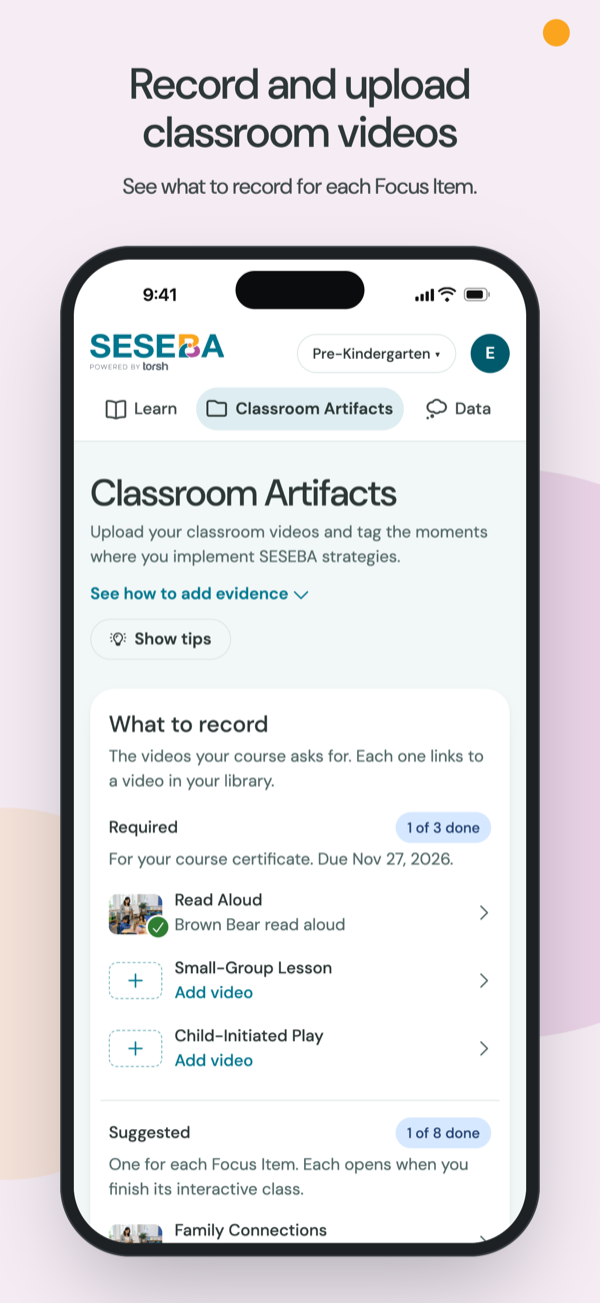
SESEBA helps preschool teachers support children who are learning in English without giving up their home language. It began as an in-person coaching framework within an academic setting, in which a coach guided each of these teachers through the method. Teachers already recorded their lessons and uploaded the videos for the coach to review. In the digital version, recording and uploading become the center of the routine, and teachers themselves, with help from AI, find in those videos the evidence of their practice. I designed the experience that lets teachers follow the method on their own, from the learning path to the AI Coach features.
- Client
- Torsh, via Quave
- My role
- Product Designer
- Year
- 2026
- Platform
- Web, iOS and Android
Outcomes
Coaching without a coach in the room
SESEBA is a framework developed by researchers at Rutgers University. It defines what high-quality support for multilingual children looks like and organizes it into concrete practices in which a teacher can progressively develop.
In the in-person format, the coach was responsible for half of the cycle: defining what to record, reviewing the videos, assessing the practice and setting the next goal.
The core challengeTransfer the coach's responsibility to the product without losing the rigor of the method.
The coach also filtered the method's complexity. With 8 chapters, 97 strategies and three levels, the coach was the one telling teachers what mattered right now. Without the coach, that filter became design's job.
There was a second tension. Districts buy SESEBA, but teachers do the work. If the product added weight to their day, it would not be adopted, however good the method. So reducing teacher effort became a design criterion at every step, and the pilot was run with teachers as co-researchers.
How to solve the challenge?
I mapped each step of the in-person cycle and defined who would carry it in the digital experience: the product itself, the teacher or the AI Coach. What used to depend on the coach's judgment became navigation, guidance at the right moment, and suggestions the teacher confirms.
Each step of the cycle and who carries it, in both formats.
Introducing AI without making teachers feel evaluated
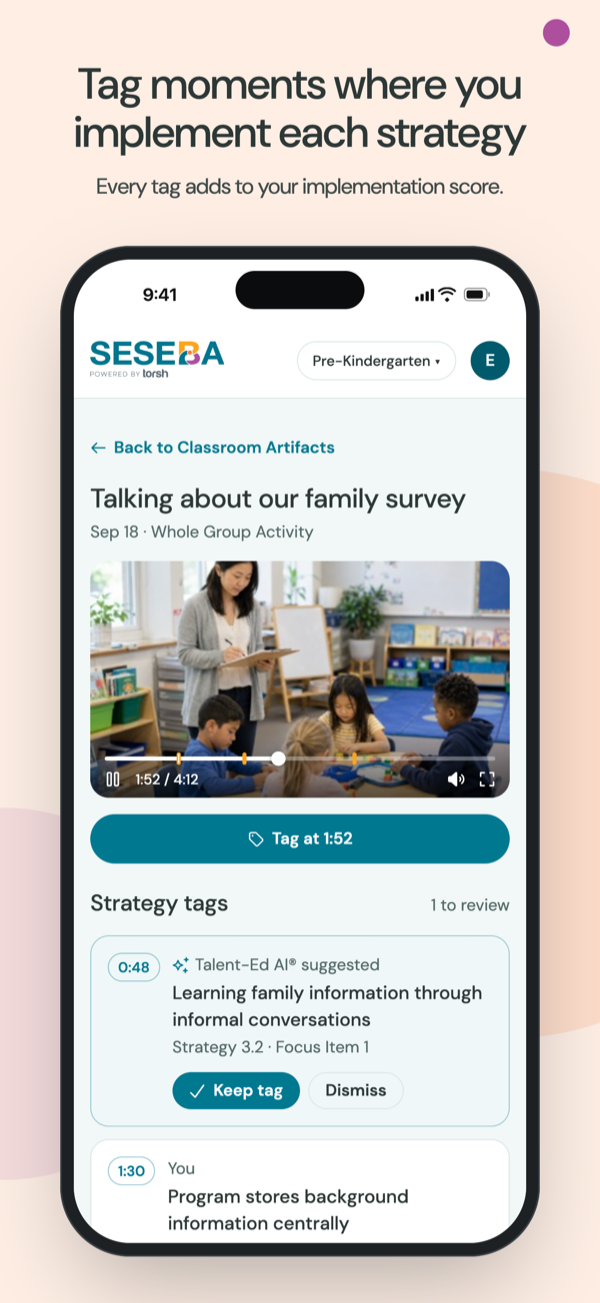
Asking teachers to record their own classrooms requires trust. If the AI were perceived as an evaluator, adoption would suffer. I designed the AI Coach features around a human-in-the-loop principle, so that the teacher remains in control at every step: from how tags are suggested to how the AI talks about practice.
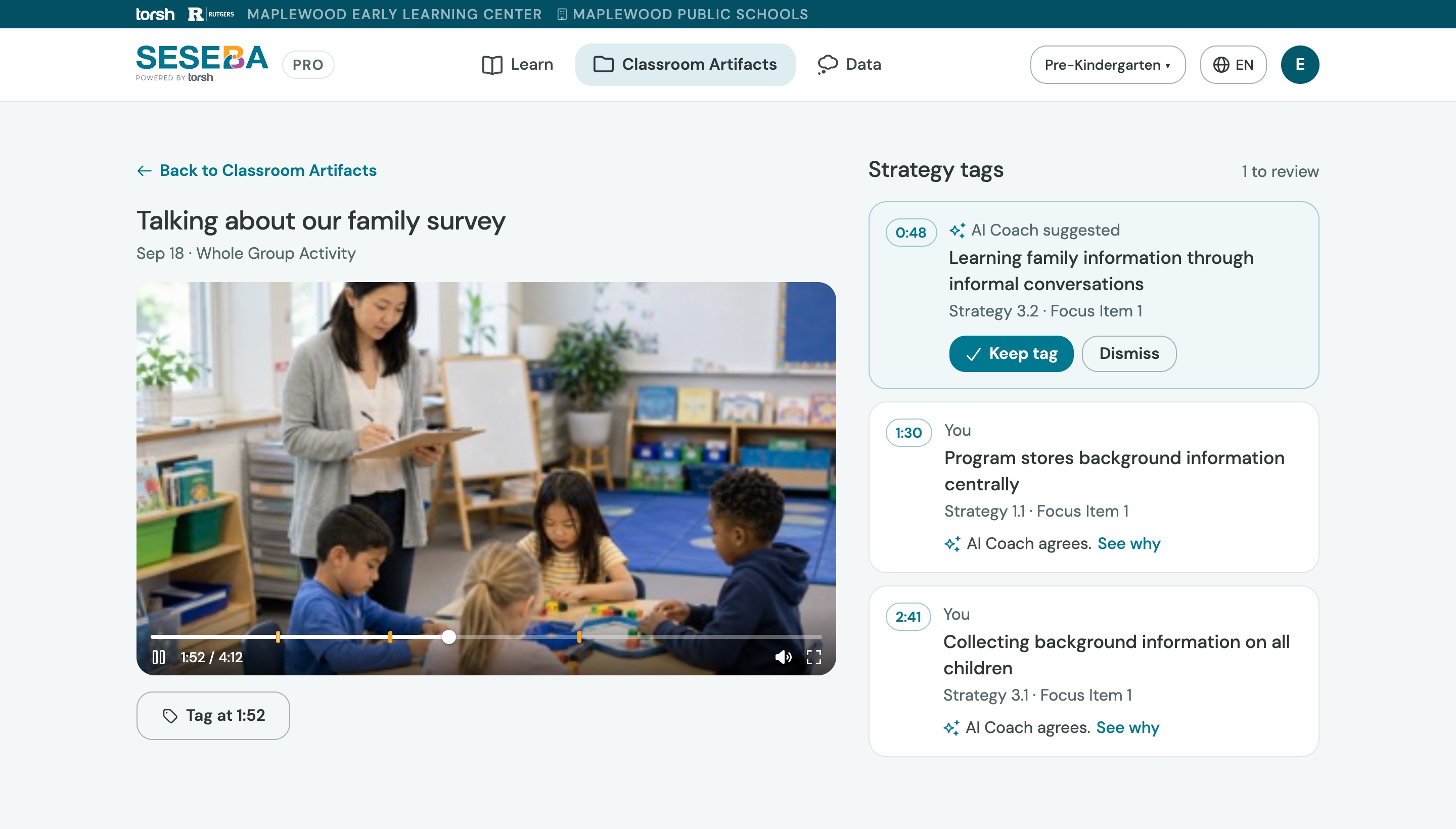
Try it: the AI suggests moments, and you decide what counts as evidence.
 Classroom video · Morning circle Illustrative transcript
The AI Coach reviews the video as it plays.
- 0:42
“Good morning, Mateo! ¡Buenos días! Can you help me say it in Spanish?”
Analyzing this moment…
AI suggestionDismissedIdentified strategy:5.2 Children share words and traditions from home
Why the AI suggested thisThe teacher greets the class in English and Spanish and invites Mateo to teach a word from home. The home language is treated as a resource, which is what strategy 5.2 describes.
- 1:48
“Ana, you can tell us in Portuguese or English, whichever you like.”
Analyzing this moment…
AI suggestionDismissedIdentified strategy:3.3 Children feel free to talk in the language they choose
Decisions that keep the teacher in charge
- Every suggestion explains itself. Each AI tag comes with a confidence level and a rationale, so the teacher can judge it instead of trusting it blindly.
- Dismissing teaches back. When a teacher declines a suggestion, they say why, for example “Evidence doesn't match.” Human judgment is recorded, not overridden.
- The teacher sets the AI's role. In settings, teachers choose whether the AI tags strategies automatically or sends everything to manual review.
- AI is a layer, not a requirement. Foundations, Plus and Pro share one design. Plus keeps manual tagging and a transcript without framing it as AI; Pro adds the AI coach. The same flows work with or without it.
- The AI never contradicts the coach. The team dropped the idea of showing that the AI “disagrees” with a coach's tag. Where the AI adds something, it is framed as a coaching tip.
The chat is an assistant inside the learning modules. It follows the same principle: it explains strategies and proposes classroom ideas, while the next step and the score stay grounded in the teacher's own evidence.
- Visible reasoning. While it works, the assistant shows its steps in plain language instead of a spinner.
- The teacher stays free. The window can be closed during a longer answer; the reply waits for them.
- Available to everyone. The team chose to include the assistant in the free tier too, as part of the learning experience rather than a reason to upgrade.
Strategy 3.3 is about children feeling free to talk in the language they choose. For example, during morning circle you might say: “You can tell us in Spanish or English, whichever you like.” Try offering that choice once a day this week, then record a moment to add as evidence.
The method became the navigation
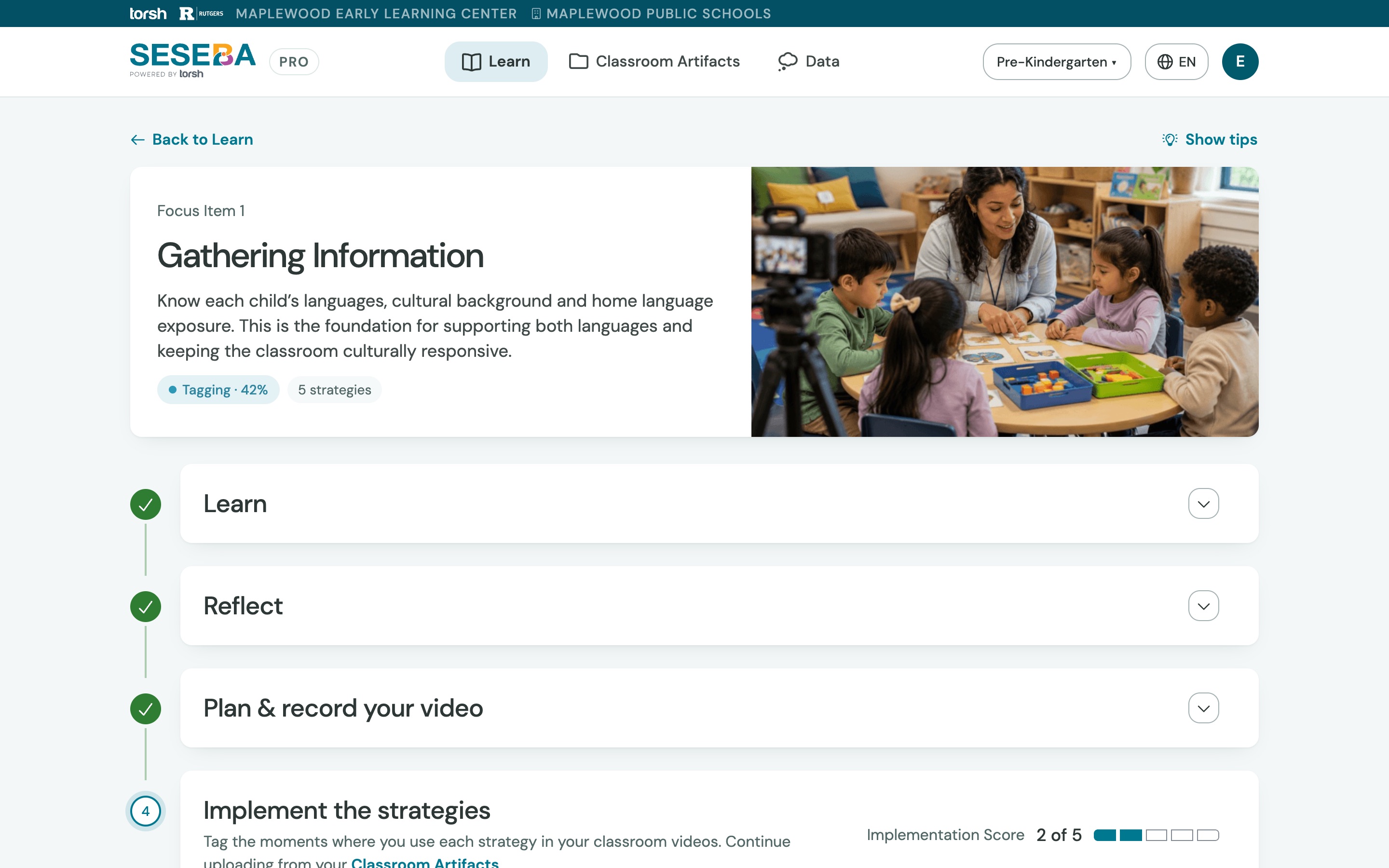
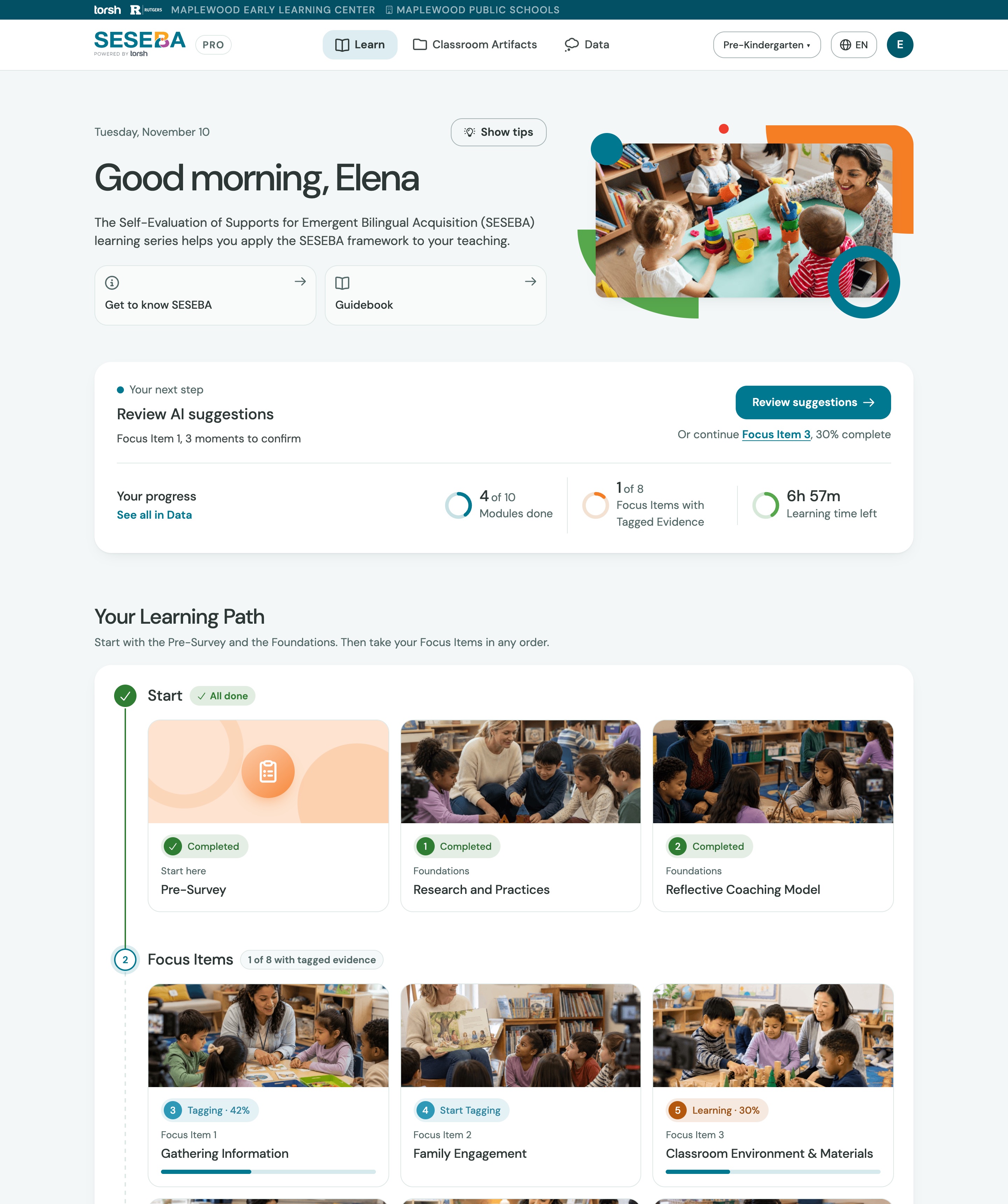
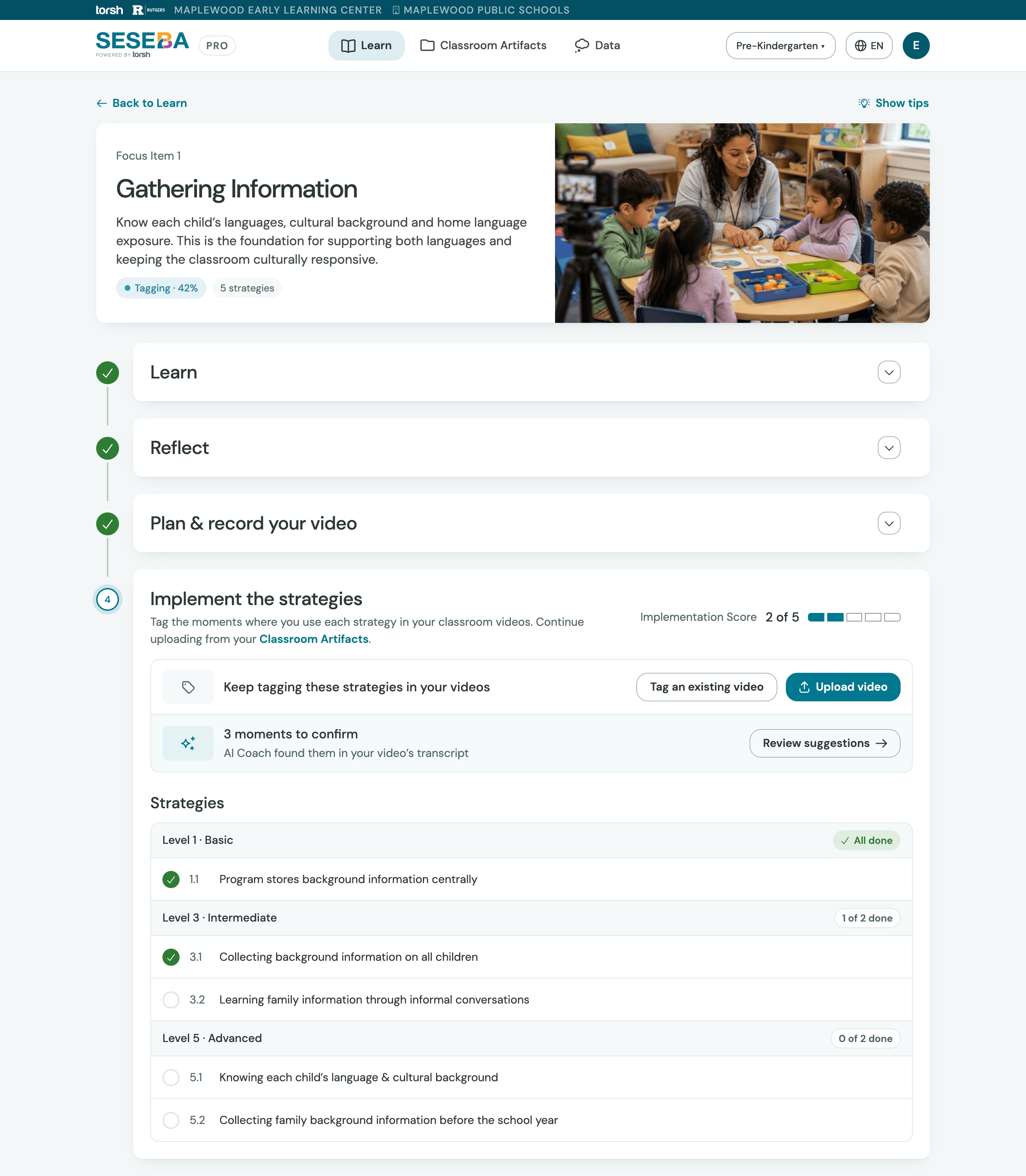
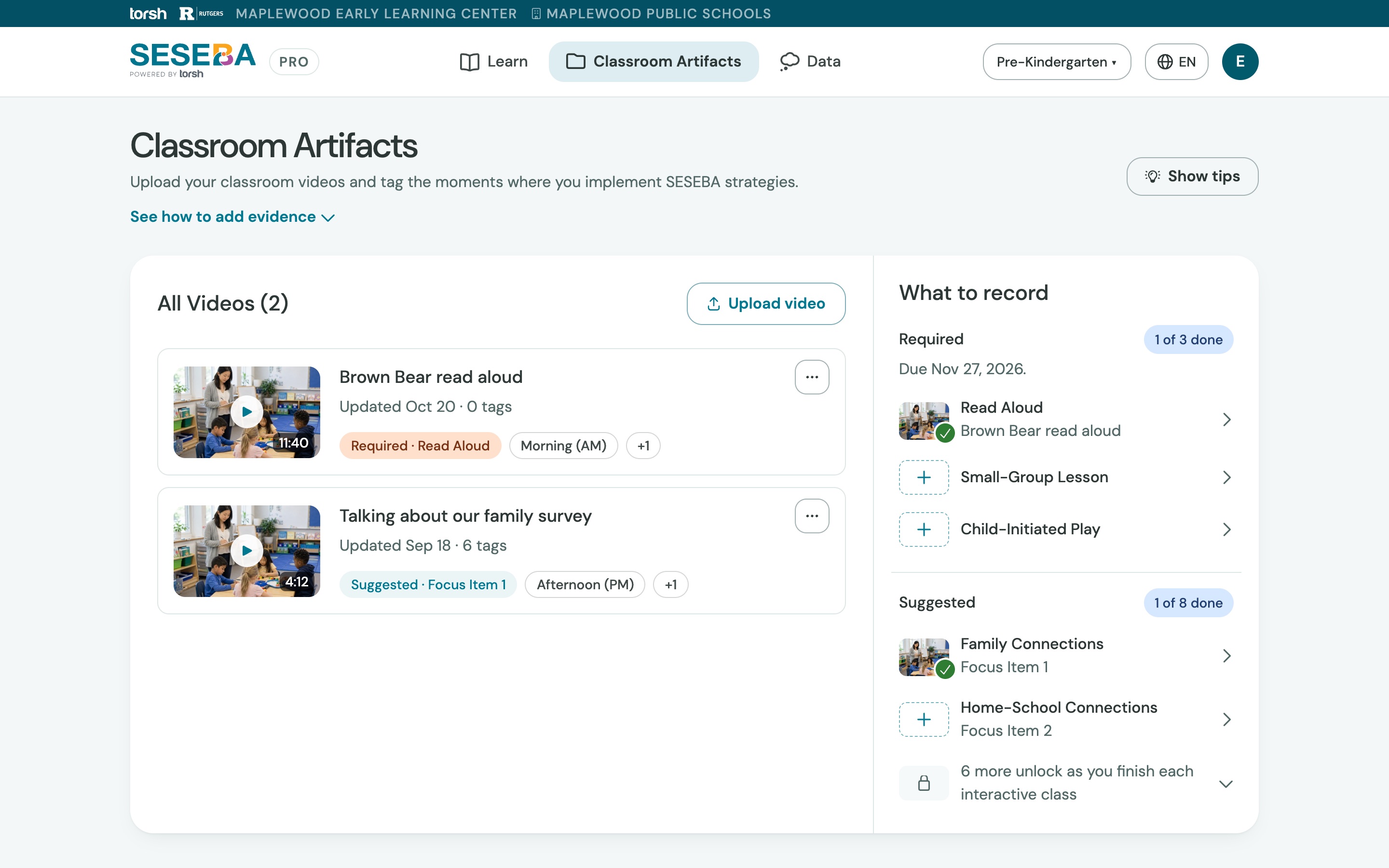
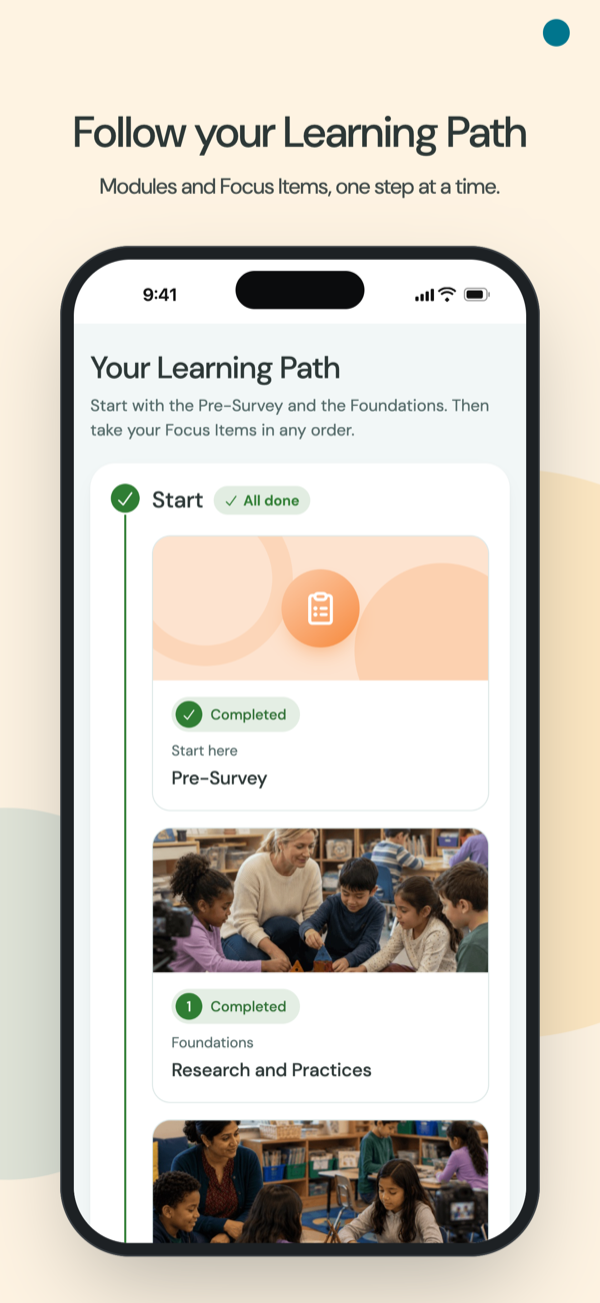
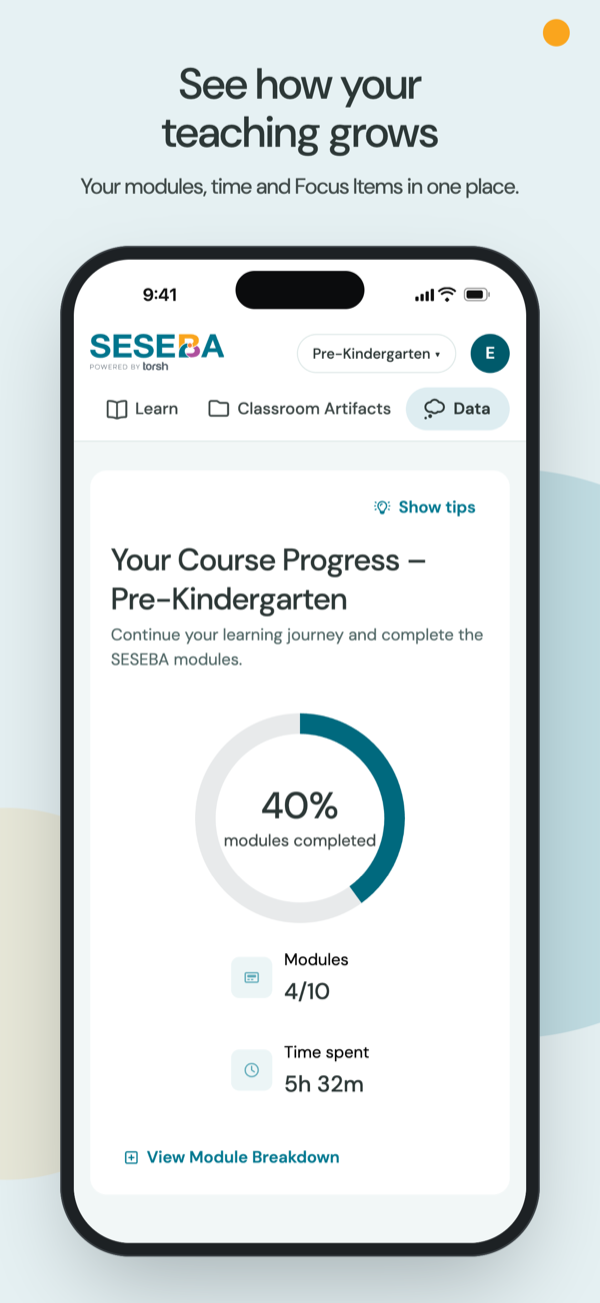
The teacher's entire journey is organized in a single Learning Path. Each chapter works as a hub built on the same three moves: learn, reflect and implement. Videos have a library of their own, since a single recording may demonstrate several strategies. Every area of the product corresponds to a step of the cycle.
↺ A new Next Step starts the next chapter
One thing at a time
- 1 One focus.
A single Next Step tells the teacher what to do now, on every screen.
- 2 Progressive disclosure.
Strategies, levels and evidence goals stay hidden until the teacher needs them. The method's full complexity is there, but it never shows up all at once.
- 3 Steps, not walls of text.
Instructions became visual steps with time estimates, so teachers know the size of each task before starting.
SESEBA
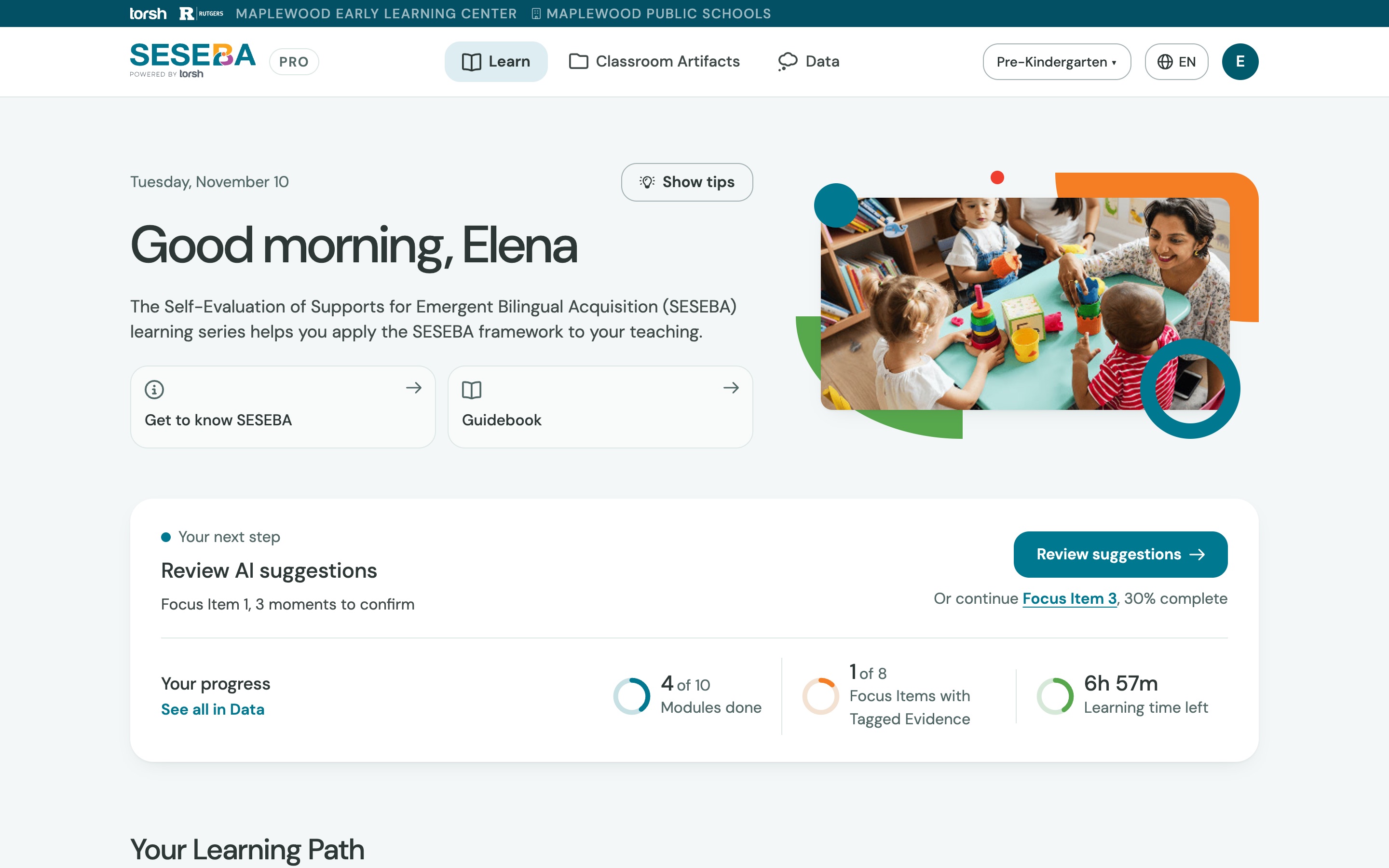
A single starting point for each day, a path that makes progress visible, and AI that takes on the most time-consuming part of the work.
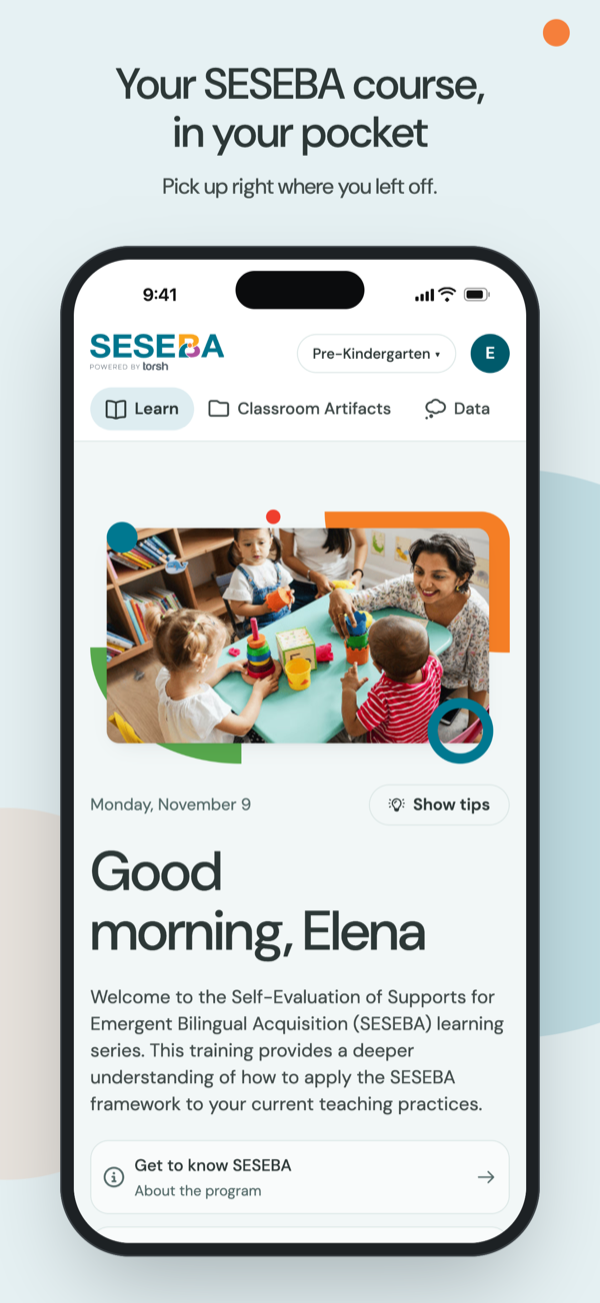
The same experience, delivered on iOS and Android.
Key takeaways
Turning a method into a product is not about digitizing what already existed. It is about deciding who takes on each responsibility.
SESEBA is still in its first cycles of real use, so there isn't enough usage data yet to measure impact. The learnings below come from the pilots, the demos and the rollout with the first district.

- The buyer is not the user.
Districts buy SESEBA; teachers carry it. A method can be excellent and still fail if it adds weight to a teacher's week. Designing for adoption meant treating teacher effort as a constraint as strict as the framework itself, and building the pilot with teachers as co-researchers.
- AI has to feel light.
In a teacher's day, the AI works as an assistant, not an evaluator: it suggests moments, explains why, and gets out of the way. If it fails, the teacher keeps tagging by hand; if they disagree, they dismiss it. Even tone matters: the AI never contradicts a coach, it offers a tip. That lightness is what lets AI into the classroom without adding weight for people who already have little time.
- Simplicity is an editing job.
The method stays whole: 8 chapters, 97 strategies, three levels and an evidence target for every strategy. In person, the coach decided what a teacher needed to see each week. Without the coach, that editing moved into the interface: a single Next Step, a chapter that opens one move at a time, and strategy detail only when the teacher reaches implement. Nothing from the framework was cut; design decides what appears, and when.
- AI fills the gap software could not.
For years, SESEBA coaching could not be fully digitized: someone had to watch the videos and recognize, moment by moment, which strategies were in use. That was the bottleneck keeping the method in person. AI occupies exactly that space in the flow, not as an extra feature but as the piece that makes a digital version possible at all. The lesson was to design from that gap: find where only a person could act, place the AI there, and keep the final judgment with the teacher.